

General education only; not a substitute for examination or diagnosis.
What this area covers
Children's ear, nose and throat structures differ from adults'. The Eustachian tube, which connects the middle ear to the back of the nose, is shorter and more horizontal, so middle-ear infection and fluid often follow a cold. The adenoids and tonsils are relatively large in early childhood, while the airway is narrower. These differences explain complaints such as snoring, mouth breathing and noisy breathing.
In childhood, hearing is critical for speech and language development. Paediatric ENT assessment therefore considers not only the disease but also the child's development, sleep and school life.
- Acute middle-ear infection (acute otitis media) and frequently recurring ear infections.
- Fluid in the middle ear without signs of acute infection (otitis media with effusion, often called glue ear).
- Enlarged adenoids, enlarged tonsils and recurrent tonsillitis.
- Snoring and obstructive sleep apnoea (obstructive sleep-disordered breathing) in children.
- Congenital or acquired hearing loss and newborn hearing screening.
- Foreign bodies in the ear, nose or airway; button batteries are particularly dangerous.
- Noisy, high-pitched breathing (stridor) and hoarseness.
Symptoms
- Ear pain, pulling at the ear, fever, irritability and poor sleep, sometimes with ear discharge.
- Slow response when called, turning the television up, delayed speech or attention problems at school, which can suggest reduced hearing from middle-ear fluid.
- Regular snoring, pauses in breathing during sleep, sleeping with the mouth open, restless sleep, night sweats or bedwetting.
- Daytime tiredness, poor attention, behavioural problems or poor growth.
- Constant nasal blockage, a nasal-sounding voice and mouth breathing.
- One-sided, foul-smelling nasal discharge, which may point to a forgotten foreign body in the nose.
- A high-pitched sound when breathing in (stridor) or a sudden coughing fit.
When to see a doctor
Situations that need urgent care
- If a button battery may have been swallowed or put into the nose or ear, take the child to the emergency department immediately, even if they seem well. A battery lodged in the food pipe can cause serious burns in about two hours; do not give food or drink and do not try to make the child vomit.
- Difficulty breathing, stridor at rest, the chest pulling in, blue colour or being unable to swallow saliva: call emergency services (112).
- A sudden bout of coughing or choking while eating or playing, followed by ongoing wheeze or noisy breathing; a foreign body may have entered the airway.
- Swelling and redness behind the ear, the ear being pushed forward, high fever or neck stiffness.
- Any bleeding from the mouth or nose, frequent swallowing or vomiting blood after tonsil surgery.
Situations for a planned appointment
- Babies who do not pass newborn hearing screening; a full hearing assessment is ideally completed before three months of age.
- Delayed speech or suspected hearing difficulty.
- Middle-ear fluid lasting longer than three months, or frequently recurring ear infections.
- Regular snoring and pauses in breathing during sleep.
- Frequent throat infections or constant nasal blockage.
Symptoms in children are not always obvious. A definite diagnosis and treatment decision can only be made after examination.
How it is diagnosed
- Detailed history: parents are asked about how often infections occur, sleep, speech development and school progress.
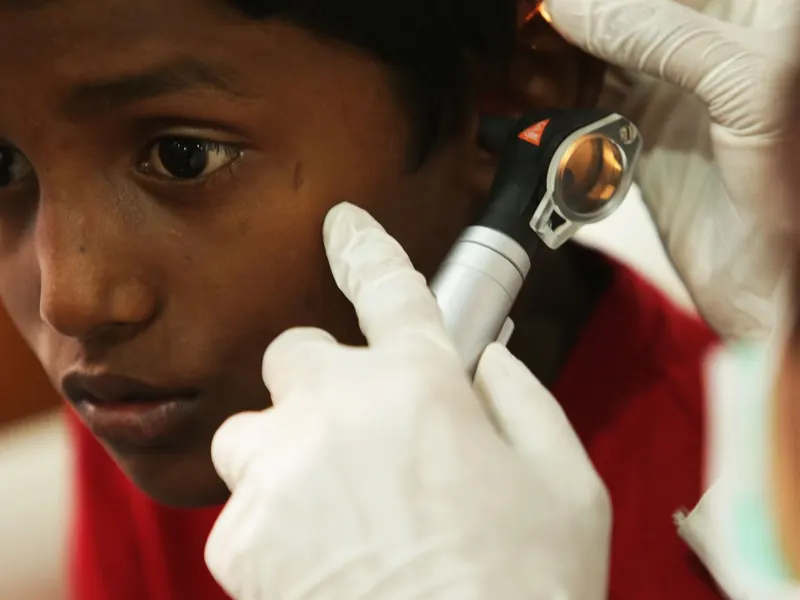
- Ear examination: pneumatic otoscopy is recommended to diagnose middle-ear fluid, with tympanometry added if the diagnosis is uncertain.
- Age-appropriate hearing tests: otoacoustic emissions (OAE) and auditory brainstem response (ABR) in babies, and behavioural or play audiometry and pure-tone audiometry in older children. A hearing test should be done if middle-ear fluid lasts three months or longer.
- Nose and adenoid assessment: in suitable children a thin flexible endoscope is used to look at the adenoids and the back of the nose.
- Sleep study (polysomnography): recommended before tonsil surgery in children with sleep-disordered breathing who are under two years old or who have obesity, Down syndrome, craniofacial anomalies, neuromuscular disease, sickle cell disease or mucopolysaccharidoses.
- Foreign bodies and stridor: X-ray and, when needed, endoscopic examination under anaesthesia (laryngoscopy, bronchoscopy or oesophagoscopy).
Treatment options
Watchful waiting and conservative care
- Middle-ear fluid often clears on its own. The 2016 AAO-HNSF guideline recommends three months of watchful waiting from the onset of fluid (or from diagnosis if onset is unknown) in children who are not at risk.
- For recurrent throat infections, watchful waiting is recommended if there have been fewer than seven episodes in the past year, fewer than five per year in the past two years or fewer than three per year in the past three years.
- In acute otitis media, pain and fever control come first; depending on the child's age and severity, short observation or antibiotics are planned.
Medicines
- Nasal or oral steroids, antibiotics, antihistamines and decongestants are not recommended for middle-ear fluid; they have not been shown to give lasting benefit.
Procedures and surgery
- Ventilation tubes: according to the 2022 AAO-HNSF guideline, tubes are not inserted for a single episode of fluid lasting less than three months. Bilateral tubes are offered to children with fluid in both ears for three months or longer and documented hearing difficulty. In recurrent acute otitis, tubes are offered if fluid is present at assessment, but not if there is no fluid.
- Adenoidectomy: in children under four having surgery for middle-ear fluid, tubes alone are usually recommended, and adenoids are removed only if there is a separate reason such as nasal obstruction. From age four, tubes, adenoidectomy or both are options.
- Tonsillectomy: may be considered in children with at least seven throat infections in the past year, at least five per year for two years or at least three per year for three years, with each episode documented (the Paradise criteria). Each episode must include sore throat plus at least one of fever above 38.3 °C, enlarged neck lymph nodes, tonsillar exudate or a positive streptococcal test.
- Tonsillectomy is recommended for children with obstructive sleep apnoea confirmed by a sleep study; enlarged adenoids are usually removed at the same time.
- Foreign bodies in the ear, nose or airway are removed with suitable instruments, under anaesthesia when needed; button batteries must be removed urgently.
Before and after surgery
Before surgery, the child's general health, any bleeding tendency and previous anaesthetic experiences are reviewed and an anaesthetic assessment is carried out. Regular medicines should only be adjusted on the advice of the treating physician.
After tonsillectomy, sore throat usually lasts from a few days to two weeks. Paracetamol and ibuprofen are recommended for pain; codeine or medicines containing codeine must not be used in children under twelve. Plenty of fluids are important. Overnight hospital monitoring is recommended for children under three or with severe sleep apnoea.
- Any bleeding from the mouth or nose in the first two weeks after tonsillectomy, even a small amount, needs urgent assessment.
- After ventilation tubes, routine earplugs or avoiding swimming are not recommended. If a tube ear discharges, antibiotic ear drops alone are usually enough.
Follow-up
- Children with tubes have their ears checked within three months of surgery, with regular examinations until the tubes come out.
- Children with persistent middle-ear fluid who do not have tubes are reassessed every three to six months until the fluid clears or significant hearing loss or structural changes of the eardrum are found.
- For babies who do not pass newborn screening, the aim is diagnosis by three months at the latest and, when needed, support starting by six months.
- In children operated on for sleep apnoea, symptoms can persist or return; reassessment is needed if snoring continues.
Frequently asked questions
Sources
The general information on this page is based on the guideline and institutional sources below. Individual diagnosis and treatment decisions require an examination.
- AAO-HNSF Clinical Practice Guideline: Otitis Media with Effusion (Update, 2016)
- AAO-HNSF Clinical Practice Guideline: Tympanostomy Tubes in Children (Update, 2022)
- AAO-HNSF Clinical Practice Guideline: Tonsillectomy in Children (Update, 2019)
- Great Ormond Street Hospital (NHS) — Button batteries: using them safely
- National Capital Poison Center — Button battery ingestion: first aid and risks
- NIDCD — Your baby's hearing screening and next steps